
If you look at the AI landscape today, the default choice is obvious: Python.
It's the lingua franca of machine learning. The libraries are there, the tutorials are there, and the path from "Hello World" to "Working Prototype" is incredibly fast.
So when we started building Rig, our open-source framework for AI agents, and the Ryzome platform itself, the logical choice was to stick with the herd. Instead, we chose Rust.
This wasn't an aesthetic choice. We aren't Rust evangelists trying to convert you to the Church of the Crab (though, admittedly, the mascot is based). We're pragmatists building infrastructure. We chose Rust because we found that while Python is great for experimenting with AI, it struggles to orchestrate it at scale.
Here's the engineering reality behind that bet.
Rust Handles Concurrency Without the Bottlenecks
To understand why we moved, you have to understand the bottleneck of a modern AI agent.
An agent isn't one linear conversation. A sophisticated agent is doing ten things at once: streaming tokens from a model, searching a vector database, calling an external API, writing to a log file.
In Python, handling this concurrency is surprisingly brittle. One synchronous function that blocks the main thread, and the entire system stutters. Every other task waits in line behind it.
Rust, specifically with the tokio runtime, handles this differently.
It uses work stealing, a method where idle threads pick up tasks from busy ones. We can run large numbers of concurrent agents without blocking the main thread. No workarounds. No careful threading gymnastics.
| Python | Rust | |
|---|---|---|
| Concurrency model | GIL bottleneck. One thread often blocks the others. | True parallelism. Threads run independently and safely. |
| Failure mode | Easy to accidentally freeze the system. | The type system prevents data races at compile time. |
| Scaling | Requires complex workarounds. | Trivial. Add more tasks. |
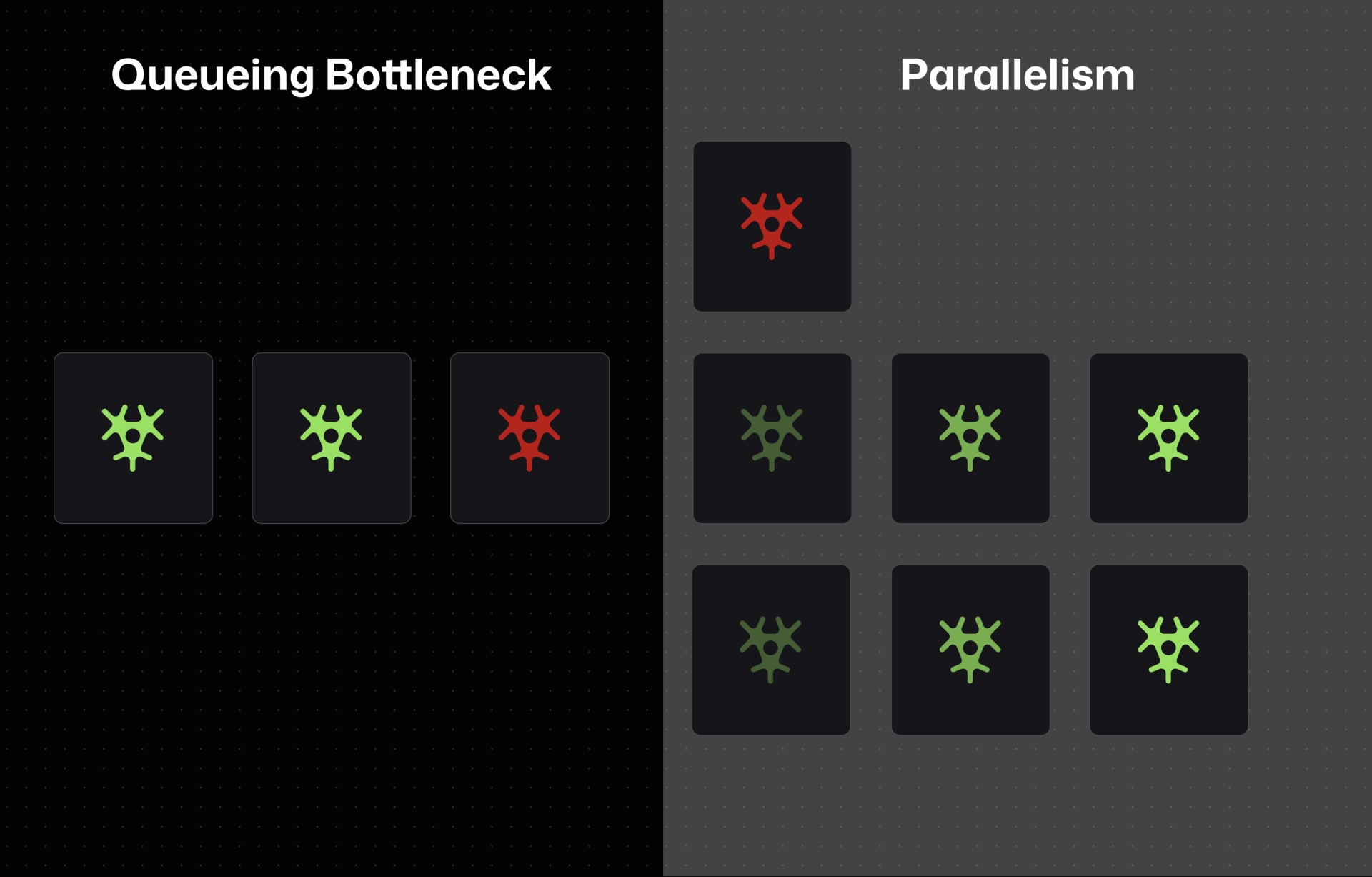
We don't want your agent waiting in line.
The Compiler Catches Errors Before The Users Do
Here's a tension every developer knows: speed of writing vs. speed of debugging.
Python lets you write code fast. But because it's dynamically typed, you often discover edge cases only when a user hits them in production.
Rust is rigorous during development. Sometimes demanding. But it offers a specific promise: if it compiles, it usually works.
Rust uses Algebraic Data Types and exhaustive pattern matching. In practical terms, the compiler forces us to handle every possible outcome.
- Did the database connection fail?
- Did the model return an empty string?
- Did the API timeout?
In dynamically typed languages, it's easy to miss an error handler for one of these scenarios, causing the app to crash silently at 3 AM. In Rust, the code won't compile until we've defined what happens in every single case.
We're encoding the failure modes into the system. This rigidity acts as a permanent regression test. It makes collaboration easier because we can be certain that new code committed by a teammate won't subtly break an existing contract.
Every Agent Action Is Logged, Validated, and Reversible
This is a bit technical, but it's crucial for how Ryzome thinks.
In many frameworks, when an agent decides to call a tool, like searching the web, it executes the function immediately. There's no inspection layer, no safety check, no record of what was attempted.
In Rust, we model these Actions as Data. Instead of running code directly, the agent produces a strict data structure that represents the intent to run code. This allows us to:
- Pre-validate: Check if the action is safe before executing.
- Guarantee atomicity: Ensure complex multi-step actions happen all at once or not at all.
- Observe everything: Log exactly what the agent tried to do, even if it failed.
It turns the black box of agent behavior into a transparent log that we can audit, debug, and improve.
Rust's Ecosystem Is Production-Ready
There's a persistent myth that Rust is stagnant or overly academic. The reality is the opposite.
Backwards compatibility
We gain new features without breaking old code. The stability guarantees mean we spend time building, not migrating.
Cargo
The package manager is a genuine pleasure to use. Dependency management, building, testing, and publishing all work through a single tool with consistent behavior. If you've ever wrestled with Python environment management, you know why this matters.
Performance culture
The community cares deeply about efficiency. When we pull in an open-source crate, we can usually trust that it's optimized for speed and correctness.
And yes, the mascot is a crab. Which is objectively great. 🦀
We Do the Hard Work So the Product Doesn't Break
We didn't choose Rust because it was the easy path. We chose it because we're building a tool for high-leverage work.
When you're using Ryzome to manage your company's strategy or debug a complex issue, you don't care about how fast we wrote the code. You care that it doesn't crash, that it doesn't hang, and that it handles your data with precision.
We do the hard work in the compiler so you don't have to do it in the chat.